
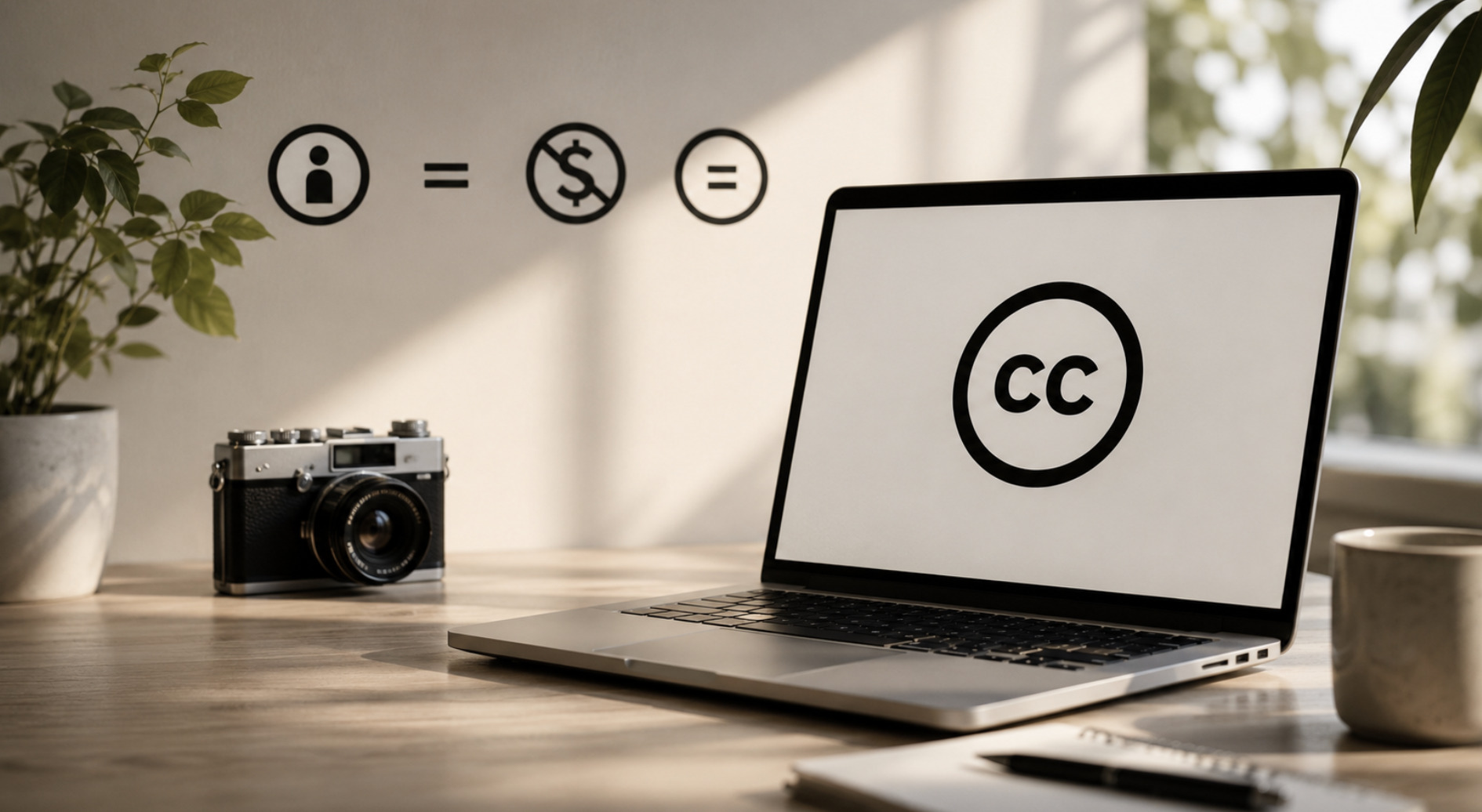
Using Creative Commons material is one of the great pleasures of the open web: millions of images, articles, songs, and videos, free to reuse. But that freedom comes with one small, non-negotiable obligation for almost every CC licence — attribution. Get it right and you honour the creator, stay on the right side of the licence, and strengthen the whole open ecosystem. Get it wrong, or skip it, and you may be infringing copyright even though the work was free to use. This guide explains exactly how to attribute a Creative Commons work correctly, with a simple framework and concrete examples you can apply immediately.
Why attribution is required, not optional
It surprises many people that using a "free" work can still land them in breach of copyright, but that is precisely how Creative Commons functions. A CC licence does not surrender the creator's copyright; it grants you permission to use the work on certain conditions. For every licence except the public-domain tools, the foremost condition is attribution — signalled by the "BY" that appears in almost every licence name. Fail to meet the condition, and your permission to use the work evaporates.
This matters because attribution is the currency of open culture. Creators share their work freely in exchange for credit — recognition, discoverability, and the traffic that a link sends back to them. When you attribute properly, you are not performing an empty formality; you are upholding the bargain that makes the entire commons possible. Understanding which licence you are dealing with is the essential first step, and our guide to Creative Commons licences breaks down what each one permits and requires.
The TASL framework: the four things you need
Creative Commons recommends a simple, memorable formula for what a good attribution contains. The mnemonic is TASL, standing for Title, Author, Source, and Licence. Include those four elements and you have covered the essentials of a proper credit.
Title is the name of the work, if it has one. Author is the person or organisation the creator wants credited — sometimes their real name, sometimes a username or pseudonym, whatever they have specified. Source is a link back to the original work, so others can find it and verify the licence. Licence names the specific CC licence and, ideally, links to the licence deed, so a reader can see exactly what they too are permitted to do. Assemble these four pieces and you have an attribution that satisfies the licence and genuinely serves the creator.
Putting it together: a worked example
The theory is simple; seeing it in practice makes it stick. Suppose you want to use a photograph titled "Mountain Dawn," taken by a photographer credited as Jane Doe, found on a photo-sharing site, released under the CC BY 4.0 licence. A complete, correct attribution would read something like:
"Mountain Dawn" by Jane Doe, licensed under CC BY 4.0.
Ideally, three of those elements are hyperlinked: the title links to the original work, the author's name links to their profile or page, and the licence name links to the licence deed. That single line, with its links, delivers all four TASL components cleanly. Notice how little it takes — attribution does not need to be long or awkward. It needs to be complete, accurate, and placed where a viewer can reasonably find it, such as a caption beneath an image or a credits line at the end of an article.
Adapting attribution to different media
The TASL principles are constant, but how you present them shifts with the medium, and a little common sense goes a long way. For an image on a web page, a caption directly beneath it, or a credit line nearby, is the natural home for the attribution. For text you have quoted or adapted, a note within or at the foot of the article does the job. For video, credits can appear on screen or in the description; for audio, in the show notes or accompanying text.
The guiding rule, stated by Creative Commons itself, is that attribution should be "reasonable to the medium." You are not expected to plaster a licence deed across a photograph, but you are expected to provide the credit in a way that someone encountering the work can actually find. When in doubt, be more generous rather than less: a clearly visible, complete credit protects you and respects the creator, while a buried or partial one risks both the licence and the relationship.
Handling adaptations and the ShareAlike condition
Attribution gets one important wrinkle when you modify a work rather than using it as-is. If you crop, edit, translate, or otherwise adapt a CC work, best practice is to say so — indicating that changes were made, so no one mistakenly attributes your alterations to the original creator. A note as simple as "cropped from the original" or "translated from the original" keeps the record honest.
Adaptations also raise the question of the ShareAlike ("SA") condition, present in some licences. If the work you built upon carries a ShareAlike licence, you are required to release your adaptation under the same licence. That means your attribution should also state the licence your new version carries, which may be the same as the original. Getting this right keeps a chain of open works genuinely open, which is exactly what ShareAlike is designed to guarantee. When you adapt, in short: credit the original, flag your changes, and honour any ShareAlike requirement in how you licence the result.
Common mistakes to avoid
A few errors turn up again and again, and knowing them is half the battle. The most frequent is providing no source link — a credit that names the author but gives no way to find the original fails a core part of the requirement. Another is omitting the licence entirely, so readers cannot tell what they are permitted to do with the work. A third is assuming that a work with no visible licence is free to use; absence of a licence usually means all rights reserved, not that the work is open.
Two more deserve special mention. Do not confuse CC0 or public-domain works, which require no attribution, with licensed works, which do — though even for public-domain material, crediting the source remains good practice and helps others. And never treat "I found it on the internet" as permission; the fact that a work is easy to copy says nothing about whether you are licensed to use it. For works whose copyright has genuinely expired, our explainer on the public domain covers what you are free to do.
Conclusion
Attributing a Creative Commons work correctly is neither difficult nor onerous once you know the framework. Identify the licence, gather the four TASL elements — title, author, source, and licence — and present them in a way that fits the medium and is easy to find. Flag any changes you make, honour ShareAlike when it applies, and avoid the handful of common mistakes, above all the missing source link. Do this consistently and you turn a legal obligation into a small act of generosity: one that keeps you compliant, sends credit and traffic back to the people who shared their work, and helps sustain the open commons that everyone draws from. Good attribution is how the free web stays free.